
Description
PrymaLab · Research Use Only
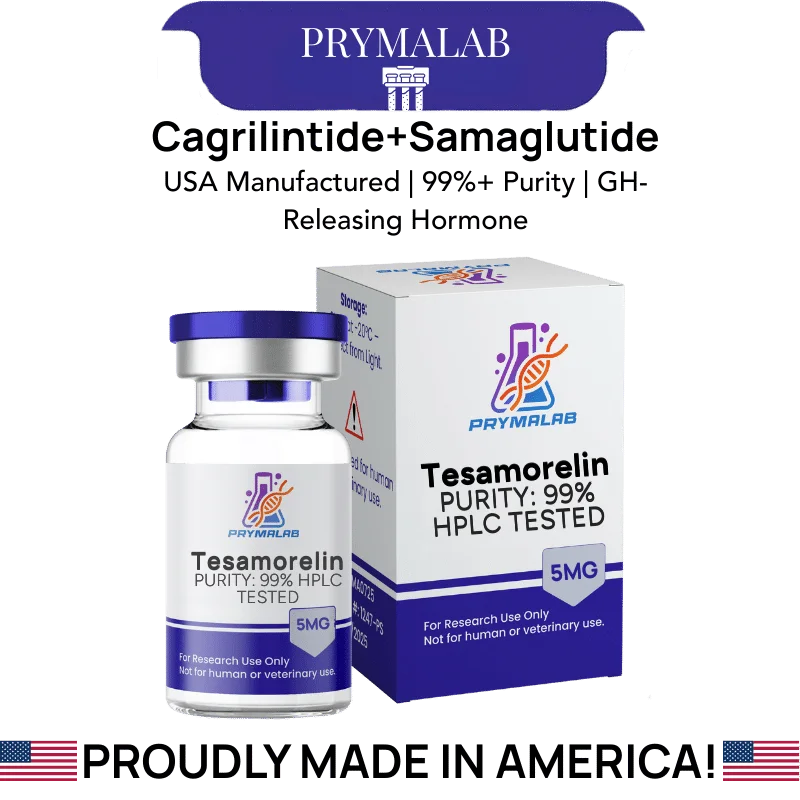
Cagrilintide 2.5mg + Semaglutide 2.5mg
Two components, two stability clocks · The solution expires on the worse one
A cagrisema peptide vial contains two acylated peptides at equal mass, and they do not degrade at the same rate. Cagrilintide comes from an amylin scaffold with a known tendency to self-associate, which is what the AM833 design work was addressing. Semaglutide is better behaved. In one vial, the solution expires on the worse of the two clocks.
Specification Table
| Property | Value |
|---|---|
| Product format | Lyophilised powder, single vial, two components |
| Component 1 | Cagrilintide, 2.5 mg · approx. 4,988 g/mol · approx. 0.50 µmol |
| Component 2 | Semaglutide, 2.5 mg · approx. 4,114 g/mol · approx. 0.61 µmol |
| Total peptide content | 5 mg |
| Mass ratio | 1 to 1 |
| Molar ratio | Approximately 1 to 1.22, because the two masses differ |
| CAS, blend | Not applicable. Two-component mixture; component numbers listed separately |
| CAS, semaglutide | 910463-68-2 |
| Cagrilintide origin | Long-acting amylin analogue, designed against the aggregation of human amylin |
| Semaglutide origin | GLP-1 analogue, Aib at position 8, C18 diacid at lysine 26 |
| Governing stability component | Cagrilintide, on published aggregation behaviour of the amylin scaffold |
| Purity reporting | Per component, not as a single blend figure |
| Storage, lyophilised | -20°C, sealed, dark and dry |
| Storage, reconstituted | 2-8°C, protected from light, prepared fresh |
| Regulatory status | No approved human or veterinary formulation is supplied here |
Why Do Two Components Mean Two Clocks?
Because degradation is a property of a molecule rather than of a vial, and a cagrisema peptide vial holds two of them.
Put two peptides in one container and each carries on doing whatever it would have done alone. Nothing about sharing glass makes them degrade at a common rate.
What sharing glass does is remove your ability to handle them separately. There is one storage temperature, one reconstitution event, one solution age.
So the vial has to be managed to the requirements of whichever component is fussier, and everything you know about the other one is irrelevant to the decision.
On this pair, that is cagrilintide.
Why Is Cagrilintide the Limiting One?
Because of what cagrilintide was designed from, which is the whole reason a cagrisema peptide vial has an asymmetry in it.
Human amylin aggregates. It forms amyloid fibrils readily, and that behaviour is well documented in the physiology literature cited below. Any long-acting amylin analogue is a molecule built to resist a tendency the parent scaffold has.
The published design work on cagrilintide reports exactly that: substitutions chosen to suppress self-association while keeping receptor engagement.
Suppressed is not eliminated. A molecule engineered away from aggregation is still the member of this pair more likely to aggregate.
Semaglutide has its own surface activity, from the C18 diacid, and it is not immune. But the starting scaffold was GLP-1 rather than amylin, and GLP-1 does not have amylin’s reputation.
I want to be careful here. I have not found published stability data on this specific co-formulation at these masses, so the ordering is inferred from the components rather than measured on the blend. That inference is reasonable and it is still an inference.
What Does That Change at the Bench?
Prepare cagrisema peptide solutions fresh, and stop reasoning from semaglutide data.
A laboratory that has worked with semaglutide alone has habits: a stock that keeps for a while refrigerated, aliquots that survive, a comfortable tolerance for a solution sitting overnight.
None of those habits transfer to this vial, because the component setting the limit is the one they have no experience with.
The practical rule is to assume solution age is short and to verify rather than hope. Size exclusion chromatography on an aged aliquot will show aggregate formation if it is happening.
The smaller fill helps here and this is the honest case for it. At 2.5 milligrams each, a study finishes the vial sooner, which means less material sitting in solution while the clock runs.
That is a real advantage of buying small on this article, and it is the only one I would claim.
There is a record-keeping habit that costs nothing and settles most of this. Write the reconstitution date and time on the tube, not just the date.
Solution age on an aggregation-prone component is measured in hours to days rather than weeks, and a date alone does not tell you which end of a day you are at.
A laboratory that has this habit already will not need telling. One that does not will discover why the first time an aliquot behaves differently from the one before it, at which point the record that would have explained it does not exist.
Thirty seconds with a marker pen, once per vial, and it removes an entire category of later argument about whether a result was real.
How Should a Two Component Certificate Report Purity?
Per component. A single cagrisema peptide purity figure is close to meaningless.
Run this vial on a reverse phase column and you get two main peaks by design. The larger one is whichever component happens to be more retained and more abundant in absorbance terms, which is not the same as more abundant by mass.
A certificate reporting one purity figure has either integrated one peak and ignored the other, or summed both and reported the sum against impurities. The first is wrong and the second says nothing about the ratio.
What you want is two purity figures, one per component, plus the measured content of each against label.
Aggregate content by size exclusion belongs here too, and on this article it matters more than on either component alone.
The blend page for BPC-157 and TB-500 in this catalogue makes a related argument about certificates and mixtures. The overlap is deliberate and the compounds are unrelated.
What Does Equal Mass Give You in Moles?
Not equal moles, because the two molecules in a cagrisema peptide vial do not weigh the same.
Cagrilintide is around 4,988 g/mol and semaglutide around 4,114. So 2.5 milligrams of each is roughly 0.50 micromoles against 0.61.
That is about 22 percent more semaglutide molecules than cagrilintide molecules, from a vial labelled one to one.
Whether that matters depends entirely on whether the work cares about molar ratio or mass ratio. Anything reasoning about receptor occupancy cares about molar.
The label is honest. It says 2.5 and 2.5 and that is what is in there. The reader is the one who has to do the conversion, and the conversion is not close enough to one to ignore.
The same arithmetic applies to the 5mg plus 5mg vial in this catalogue, at twice the scale: about 1.00 micromole of cagrilintide against 1.22 of semaglutide.
Neither vial is mislabelled. Both are labelled in the unit the industry uses, and both need converting by whoever is designing around receptor occupancy rather than around mass.
What Is Published on Cagrisema Peptide as a Combination?
Clinical work on the combination exists and is cited below. Stability work on a lyophilised research co-formulation does not, as far as I can find.
The published trials used pharmaceutical formulations prepared and stored under conditions that have nothing to do with a research vial reconstituted on a bench.
So the trials tell you the combination has been studied. They tell you nothing about how long your solution lasts.
That distinction gets blurred constantly in this market, where a clinical citation is used to imply that a research preparation inherits the properties of a licensed product. It does not.
What transfers from the literature is the rationale for combining two anorexigenic pathways. What does not transfer is anything about handling.
Why Buy a Cagrisema Peptide Vial Rather Than Two?
Because a cagrisema peptide vial arrives with the ratio already fixed, which is either the point or the problem depending on the study.
Buying cagrilintide and semaglutide separately gives complete control: any ratio, any concentration, either component alone as a control arm.
It also gives two reconstitution events, two solution clocks running independently, and the pipetting error of combining them at every preparation.
The co-formulation removes that error at the cost of removing the choice. One cake, one dissolution, one ratio forever.
For work replicating a published combination at the published ratio, that is a straightforward advantage.
For work asking what the ratio should be, this vial is the wrong purchase and two single-component vials are the right one.
How Should the Vial Be Handled?
Handle a cagrisema peptide vial to cagrilintide’s requirements, and prepare solutions fresh.
Sealed at minus 20 degrees Celsius, dark and dry, until the day it is needed. Room temperature before opening.
Diluent down the wall, gentle rotation, no shaking. Both components are surface active and foam is where acylated peptides find the air-water interface.
Aliquot immediately into single-use volumes and refrigerate at 2 to 8 degrees. Do not freeze.
Low-binding consumables from the first dilution onward, for both components.
If an aliquot has sat longer than intended, run it on size exclusion before using it rather than assuming it is fine.
Published Literature
Full citations for the work named above, each confirmed against the publisher record. None of it reports stability data for a lyophilised research co-formulation of these two components, which is stated on the page rather than glossed over.
- Kruse T, Hansen JL, Dahl K, Schaffer L, Sensfuss U, Poulsen C, et al. Journal of Medicinal Chemistry. 2021;64(15):11183-11194. DOI: 10.1021/acs.jmedchem.1c00565
- Westermark P, Andersson A, Westermark GT. Physiological Reviews. 2011;91(3):795-826. DOI: 10.1152/physrev.00042.2009
- Lau DCW, Erichsen L, Francisco AM, Satylganova A, le Roux CW, McGowan B, et al. Lancet. 2021;398(10317):2160-2172. DOI: 10.1016/S0140-6736(21)01751-7
- Lau J, Bloch P, Schaffer L, Pettersson I, Spetzler J, Kofoed J, et al. Journal of Medicinal Chemistry. 2015;58(18):7370-7380. DOI: 10.1021/acs.jmedchem.5b00726
- Manning MC, Chou DK, Murphy BM, Payne RW, Katayama DS. Pharmaceutical Research. 2010;27(4):544-575. DOI: 10.1007/s11095-009-0045-6
Frequently Asked Questions
What is cagrisema peptide?
A co-formulation of cagrilintide, a long-acting amylin analogue, and semaglutide, a GLP-1 analogue. This vial holds 2.5 milligrams of each. It is supplied lyophilised for laboratory research use only and is not for human or animal consumption.
Why does the blend have two stability clocks?
Because each component degrades according to its own chemistry regardless of what shares the vial. Sharing a container removes the ability to store or reconstitute them separately, so the vial must be managed to whichever component is less stable.
Which component limits the solution life?
Cagrilintide, on the published behaviour of the amylin scaffold it derives from. Human amylin aggregates readily and cagrilintide was designed to suppress that, which reduces the tendency without removing it. No stability data for this specific co-formulation was found.
How many moles of each are in the vial?
About 0.50 micromoles of cagrilintide at roughly 4,988 g/mol, and about 0.61 micromoles of semaglutide at roughly 4,114. Equal mass gives roughly 22 percent more semaglutide molecules than cagrilintide molecules.
How should a cagrisema certificate of analysis report purity?
Per component, with a measured content figure for each against label. A single blend purity number either integrates one peak and ignores the other or sums both, and neither tells you whether the ratio is right.
Is the smaller fill better on this article?
For a study that will finish it, yes, and this is one of the few fill pages where the argument is clean. Less material means less time sitting in solution with a clock running on the less stable component.
Does the published clinical work tell me about handling?
No. The trials used pharmaceutical formulations prepared and stored under conditions unrelated to a research vial reconstituted on a bench. What transfers is the rationale for the combination, not anything about stability.
What should cagrisema reconstitution look like?
Diluent down the vial wall rather than onto the cake, gentle rotation rather than shaking, then immediate aliquoting into single-use volumes. Both components are surface active and both foam.
What is cagrisema storage temperature?
Minus 20 degrees Celsius sealed, dark and dry, for the lyophilised powder. Reconstituted solution at 2 to 8 degrees, protected from light, prepared fresh rather than held. Do not freeze the solution.
Can the components be separated?
Not by the buyer, in any practical sense. They are co-lyophilised in one cake at a fixed ratio. Anything requiring them independently needs them purchased independently, and both are available as single-component vials in this catalogue.
Why is aggregate content important on this vial?
Because size exclusion chromatography is the assay that detects self-association, and self-association is the failure mode the limiting component is prone to. On a two-component acylated vial it does more work than the purity figure.
Is this product for human use?
No. No. This is laboratory research material only. It is not a drug, food, cosmetic or dietary product, the FDA has not evaluated it, and administering it to a person or animal is not a permitted use.
Compliance Statement
This cagrilintide and semaglutide co-formulation is supplied exclusively for laboratory research use. It is not a drug, food, cosmetic or dietary product of any kind. It has not been evaluated by the FDA or any comparable authority, and no approved human or veterinary formulation is supplied here. It is not intended to diagnose, treat, cure or prevent any disease, and it must not be given to humans or animals. Published clinical work on this combination used pharmaceutical formulations and does not describe this article. Purchase is restricted to qualified researchers and institutions.
Other formats of cagrilintide + semaglutide
cagrilintide + semaglutide is also stocked as Cagrilintide 5mg, Cagrilintide 10mg, Cagrilintide 20mg preloaded 3ml pen, Cagrilintide 5mg + Semaglutide 5mg, Semaglutide 5mg, Semaglutide 10mg, Semaglutide 15mg and Semaglutide 20mg. Each listing states its own quantity and concentration, and the pen and vial comparison explains what changes between formats.










19 reviews for cagrilintide 2.5mg + semaglutide 2.5mg